Support Canada"s Troops

Showing posts with label Paris. Show all posts
Showing posts with label Paris. Show all posts
Monday, October 23, 2006
Paris - Arc de Triomphe

The Arc de Triomphe stands in the centre of the Place de l'Étoile, at the western end of the Champs-Élysées.
Commissioned in 1806 by Napoleon, shortly after his victory at Austerlitz, it was not finished until 1836. There are four huge relief sculptures at the bases of the four pillars. These commemorate The Triumph of 1810 (Cortot); Resistance , and Peace (both by Etex); and The Departure of the Volunteers, more commonly known by the name La Marseillaise (Rude).
Engraved around the top of the Arch are the names of major victories won during the Revolutionary and Napoleonic periods. The names of less important victories, as well as those of 558 generals, are to found on the inside walls. Generals whose names are underlined died in action.
The monument stands over 51 metres (165 feet) in height and is 45 metres wide. It is the second largest triumphal arch in existence.
Beneath the Arch is the Tomb of the Unknown Soldier, and an eternal flame commemorating the dead of the two world wars.
Sources: Les Cars Rouges, Paris Pages: Arc de Triomphe, Wikipedia: Arc de Triomphe


Paris - Champs-Élysées

The Champs-Élysées is a broad avenue in Paris. Its full name is "avenue des Champs-Élysées". With its cinemas, cafés, and luxury specialty shops, the Champs-Élysées is one of the most famous streets in the world. The name refers to the Elysian Fields, the place of the blessed in Greek mythology. The Champs-Élysées is also called La plus belle avenue du monde, French for "The most beautiful avenue in the world."
Every year on Bastille Day, the largest military parade in Europe passes down the Champs-Élysées, reviewed by the President of the Republic.
The Champs-Élysées is also the traditional end of the last stage of the Tour de France.
Sources: Les Cars Rouges, Wikipedia: Champs-Élysées
Paris - Place Vendôme

Place Vendome was designed by Jules Hardouin-Mansart. The sqaure was named after the residence (hôtel) of César, duc de Vendôme, the illegitimate son of Henri IV and his mistress Gabrielle d'Estrées. It is octagonal in shape and surrounded by buildings with large arches on the lower floor. Famous buildings on the square include the Hotel Ritz (no. 15) and the house where Chopin died in 1849 (no. 12).
In the centre stands a column erected by Napoleon, modelled after Trajan's Column, to celebrate the victory of Austerlitz. Its spiralling veneers of bas-relief bronze plates (by the sculptor Pierre-Nolasque Bergeret) were made out of cannon taken from the combined armies of Europe, according to his propaganda. After the Bourbon Restoration the statue of the Emperor was pulled from the top of the column and refinished as a statue of Henri IV. A replacement statue of Napoleon, however, was erected by Louis-Philippe, and another classic statue of Napoleon I by Louis-Napoleon.
Sources: Les Cars Rouges, Wikipedia: Place Vendôme
Paris - Opéra de Paris Garnier

The opulent Opéra de Paris Garnier was designed by Charles Garnier for Emperor Napoleon III. It is the most important symbol of the 19th century Second Empire baroque style. Construction of the opera building started in 1862, but it wasn't completed until 1875, partly because an underground lake was discovered during construction. The small lake still exists under the opera building. It was the hiding place of the 'Phantom of the Opera' in Paul Leroux's famous play (and in the musical based on that play by Andrew Lloyd Webber.)
A large building, it has a total area of 11,000 square metres (118,404 square feet) and a vast stage with room for up to 450 artists. The auditorium itself comprises roughly half of the total space, most of the rest being used to house necessary logistical support so that the stage demands of any opera can be met and even surpassed. This can include live horses running on a rotating stage. The opera seats only 2,200.
Legend has it that the Empress Eugénie asked Garnier whether the building was to be in Greek or Roman style to which he replied "It is in the Napoléon III style Madame!" It remains an ornate building richly decorated with friezes, columns, and winged figures among other statues and embellishments.
This richness continues inside with velvet, gold leaf, and nymphs and cherubs. The auditorium's central chandelier weighs over six tons, and its ceiling was painted in 1964 by Chagall.
Sources: Les Cars Rouges, A View on Cities: Opéra de Paris Garnier, Paris Pages: Opéra Garnier
Paris - Palais de Justice

The Palais de Justice is located in the Île de la Cité in central Paris, France.
It is built on the site of the former royal palace of Saint Louis, of which the Sainte Chapelle remains.
It houses various courts, including the Paris correctional court. It also houses the Conciergerie, a former prison, now a museum, notable because Marie Antoinette was imprisoned there before being executed on the guillotine.
Sources: Les Cars Rouges, Wikipedia: Palais de Justice, Paris Pages: Sainte-Chapelle, Paris Pages: Le Palais de Justice
Paris - Notre Dame Cathedral

The Cathédral Notre-Dame de Paris is considered by many to be the most beautiful and the most famous monument of the Ile de la Cité.
Preceeded by a Gallo-Roman temple to Jupiter, a Christian basilica, and a Romanesque church, construction of Notre-Dame de Paris began in 1163 during the reign of Louis VII. Pope Alexander III laid the foundation stone. The idea to replace the Romanesque church occupying the site - the Cathedral of St. Etienne (founded by Childebert in 528) - was that of Bishop Maurice de Sully (who died in 1196). Construction was completed roughly 200 years later in about 1345.
During the reign of Louis XIV and Louis XV, at the end of the 17th century, the cathedral underwent major alterations as part of an ongoing attempt to modernise cathedrals throughout Europe. Tombs and stained glass windows were destroyed. The North and South Rose Windows were spared this fate, however. These two windows of Notre Dame were built between 1250 and 1260, and were
 designed in the style of the High Gothic period. This is evident by how they sit flush with the wall rather than being recessed, unlike the rose window on the Western Façade which was built during the Early Gothic period. The rose window on the South wall depicts the "Triumph of Christ" along with scenes from the New Testament. These rose windows are notable for being one of the few stained glass windows in the cathedral, and indeed in all of Europe, that still have their original glasswork.
In 1793 during the French Revolution, the cathedral was turned into a "Temple to Reason" and many of its treasures were destroyed or stolen. Several sculptures were smashed and destroyed, and for a time Lady Liberty replaced the Virgin Mary on several altars. The cathedral's great bells managed to avoid being melted down, but the cathedral was used as a warehouse for the storage of food.
A restoration program was initiated in 1845, overseen by architects Jean-Baptiste-Antoine Lassus and Eugène Viollet-le-Duc. The restoration lasted 23 years and included the construction of a flèche (a type of spire) as well as the addition of the chimeras on the Galerie des Chimères.
In 1939, it was feared that German bombers could destroy the stained glass windows. As a result, on September 13, 1939, they were removed. They were restored at the end of the war.
In 1991, a major program of maintenance and restoration was initiated, which was intended to last 10 years but is still in progress as of 2005, the cleaning and restoration of old sculptures being an exceedingly delicate matter.
Sources: Les Cars Rouges, Paris Pages: Notre Dame, Wikipedia: Notre Dame de Paris
Paris - Musée du Louvre

The Louvre has been a Medieval castle, a palace of the kings of France, and a museum for two centuries. The architecture of the Palace du Louvre developed over 800 years.
The Louvre currently contains one of the world's most famous and most important art collections. It is famous for holding several of the world's most prestigious works of art, such as Leonardo da Vinci's Mona Lisa, The Virgin and Child with St. Anne, Virgin of the Rocks and Alexandros of Antioch's Venus de Milo.
The Louvre's collections are divided into 7 departments: Oriental antiques, Egyptian antiques, Greek, Etruscan and Roman antiques; Paintings, Sculptures and Objets d'Art from the Middle Ages to 1850.
Sources: Les Cars Rouges, Paris Pages: Musée du Louvre, Wikipedia: Louvre
Paris - Place de la Concorde
The Place de la Concorde is the largest public square in Paris. Originally named Place Louis XV, the square was designed by Jacques-Ange Gabriel, Louis XV's architect, for the purpose of showcasing an equestrian statue of the King — which had been commissioned in 1748 by the city of Paris and sculpted by Edmé Bouchardon. Construction of the square began in 1754 and was completed in 1763. It is actually in the shape of an octagon, and was once bordered by large moats which no longer exist.
Several decades after its construction, this square was to serve as a focal point for the bloodiest political upheaval in the history of France: the French Revolution. When the hordes of revolutionaries seized power, they renamed the square Place de la Révolution, tore down the statue of Louis XV and replaced it with a guillotine. Between 1793 and 1795, more than 1300 people were beheaded in public executions, including Louis XVI and Marie Antoinette.
At the North end of the square are two identical stone buildings, separated by the Rue Royale. The eastern one houses the French Naval Ministry, and the western one is the Hôtel de Crillon. The Rue Royale leads to the Église de la Madeleine.
The center of the square is occupied today by a giant Egyptian obelisk decorated with hieroglyphics exalting the reign of the pharaoh Ramses II. It once marked the entrance to the Luxor Temple in Egypt. The viceroy of Egypt, Mehemet Ali, presented the 3,300-year-old Luxor Obelisk to France in 1829. King Louis-Philippe had it placed in the centre of Place de la Concorde in 1833. The red granite column rises 23 metres high, including the base, and weighs over 250 tonnes. Missing its original cap, believed stolen in the 6th century BC, in 1998 the government of France added a gold-leafed pyramid cap to the top of the obelisk. The obelisk is flanked on both sides by fountains constructed at the time of its erection on the square.
Sources: Les Cars Rouges, Paris Pages: Place de la Concorde, Obélisque de Luxor, Wikipedia: Place de la Concorde, Discover France: Place de la Concorde, Obelisk of Luxor

Several decades after its construction, this square was to serve as a focal point for the bloodiest political upheaval in the history of France: the French Revolution. When the hordes of revolutionaries seized power, they renamed the square Place de la Révolution, tore down the statue of Louis XV and replaced it with a guillotine. Between 1793 and 1795, more than 1300 people were beheaded in public executions, including Louis XVI and Marie Antoinette.
At the North end of the square are two identical stone buildings, separated by the Rue Royale. The eastern one houses the French Naval Ministry, and the western one is the Hôtel de Crillon. The Rue Royale leads to the Église de la Madeleine.
The center of the square is occupied today by a giant Egyptian obelisk decorated with hieroglyphics exalting the reign of the pharaoh Ramses II. It once marked the entrance to the Luxor Temple in Egypt. The viceroy of Egypt, Mehemet Ali, presented the 3,300-year-old Luxor Obelisk to France in 1829. King Louis-Philippe had it placed in the centre of Place de la Concorde in 1833. The red granite column rises 23 metres high, including the base, and weighs over 250 tonnes. Missing its original cap, believed stolen in the 6th century BC, in 1998 the government of France added a gold-leafed pyramid cap to the top of the obelisk. The obelisk is flanked on both sides by fountains constructed at the time of its erection on the square.
Sources: Les Cars Rouges, Paris Pages: Place de la Concorde, Obélisque de Luxor, Wikipedia: Place de la Concorde, Discover France: Place de la Concorde, Obelisk of Luxor
Sunday, October 22, 2006
Paris - Grand Palais and Pétit Palais

Across from the Pont Alexandre III in Paris are the Grand Palais and Pétit Palais.
The Grand Palais was built in 1900 for the World's Fair. The construction began in 1897, following the plans of architects Deglane, Louvet and Thomas. The building measures 240 meters wide and 40 meters tall. Currently the Grand Palais houses the 'Palais de la Découverte', with interactive exhibits, a planetarium and other temporary exhibitions. Next to it, the Pétit Palais, houses the 'Musée des Beaux-Arts de la Ville de Paris' (fine arts museum).
The Grand Palais consists of stone, glass and steel architecture. The Pétit Palais was built in the Art Nouveau style.
The Pont Alexandre III connects the Grand and Petit Palais on the right bank with the Hôtel des Invalides on the left bank. The bridge, with its exuberant Art Nouveau lamps, cherubs, nymphs and winged horses at either end, was built between 1896 and 1900. It was named after Tsar Alexander III (father of Nicholas II) of Russia. It was Nicholas II who laid the foundation stone in October 1896.
The construction of the bridge is a marvel of 19th century engineering, consisting of a 6m high single span steel arch. The design was subject to strict controls that prevented the bridge from obscuring the view of the Champs-Élysées or the Invalides.
The bridge was built by the engineers Résal and Alby and inaugurated in 1900 for the Universal Exhibition.
Sources: Les Cars Rouges, Virtourist: Paris, Wikipedia: Pont Alexandre III
Paris - Hôtel des Invalides/Tombeau de Napoléon

One of our next stops was l'Hôtel des Invalides and le Tombeau de Napoléon (Napoleon's tomb).
In 1670, Louis XIV - the Sun King - founded Les Invalides near what was then called the Grenelle Plain. An old soldiers home, it was funded by a five year levy on the salaries of soldiers currently serving in the army at that time. The first stones were laid in 1671, for what was to become a complex providing quarters for 4,000. Construction followed plans drawn up by Libéral Bruant, and was completed in 1676. The Esplandade was layed out by Robert de Cotte.
Construction of the dome began in 1706. It was designed by Jules Hardouin-Mansart and completed by de Cotte after Mansart died in 1708.
Many of the arms used by the mob when it attacked the Bastille on 14 July 1789 were taken from Les Invalide on the morning of that day. Despite resistence by the posted sentries, they were overwhelmed by the mob which finally entered the underground rifle storehouse. Roughly 28,000 arms were taken.
Les Invalides houses the tomb of Napoleon Bonaparte (1769-1821) in the crypt under Mansart's dome. Napoleon was initially interred on Saint Helena, but King Louis-Philippe arranged for his remains to be brought to St Jerome's Chapel in Paris in 1840. A renovation of Les Invalides took many years, but in 1861 Napoleon was moved to the most prominent location under the dome at Les Invalides.
A popular tourist site today, Les Invalides is also the burial site for some of Napoleon's family, for several military officers who served under him, and other French military heroes.
Sources: Les Cars Rouges, Wikipedia: Les Invalides, Paris Pages: Les Invalides
Paris - Eiffel Tower

Our bus tour in Paris started at the Eiffel Tower.
Conceived in 1889 by Gustave Eiffel, the Eiffel Tower was supposed to be the temporary master piece of the Worlds Fair, which marked the centennial of the French Revolution.
But it was not dismantled as foreseen, and for over 40 years, it was the tallest building of the world, with a height of 301.80 m.
Consisting of 18 000 elements, linked by 2 million rivets, it has become one of the most famous monuments in the world and the symbol of Paris.
Sources: Les Cars Rouges, Wikipedia: Eiffel Tower
Tuesday, October 17, 2006
Our trip to Paris
Over the next few days I'll be posting pictures and descriptions of the major sites we toured in Paris. For now, I will share with you are photo album of all the sites we visited in Paris. There are 130 pictures in total. If you click on the photo below, it will open the album that contains all of the photos.

Paris FE (Forum Encounter) and Race Report
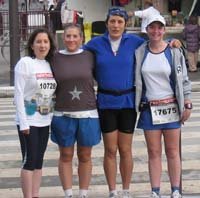 As my regular readers will know, this past weekend I was in Paris, to run the 20 Kilomètres de Paris. A few weeks ago, I had high hopes for the race, before injuring my calf two weeks before the race, and being unable to run for an entire week. The week before the race, I was able to get three short, easy runs in, so I felt confident I would be able to run the race in Paris, but not race it. That turned out to be the case.
Hubby and I flew to Paris from Munich on Friday, took a taxi to our hotel, checked in, grabbed some lunch, and then headed to the race expo to pick up my race kit (timing chip, number, etc.) The race expo was held right at the base of the Eiffel Tower. It was very small compared to the race expos I'm used to in Canada, but picking up my race kit was very quick and easy.
At the Eiffel Tower, we saw a bunch of tour buses, and hubby asked if I'd like to do a bus tour of Paris. I said sure, and off we went. It was a great way to see many of the major tourist sites of Paris, without actually having to do a lot of walking. We didn't have time to go into any of the buildings we saw, but we saw a lot.
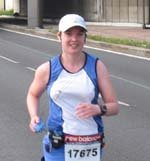 Went back to the hotel, grabbed a bite to eat, and tried to get in contact with the other European ladies running the race that I was supposed to meet up with. No luck. Two of the other women were supposed to be staying at the same hotel as us, and one of the ladies was a Paris native. However, she was on vacation the week before the race, and only due to arrive back in Paris late that night.
The next morning, we hear from the Paris native (Magali). It turns out there are *two* Mercure Tour Eiffel Hotels in Paris, just a few blocks from each other, and the other two ladies (Ammi and Martina) are staying at the other hotel. Thank goodness we found each other! Planned to hook up at the race expo, where the other ladies would pick up their race kits.
So we met up, then planned to meet at the Musée d'Orsay to view some art. Hubby and I jumped on the bus, and the other ladies decided to walk. Got off the bus at the Musée d'Orsay, went and grabbed some lunch (I had some absolutely decadent and delicious chocolate crepes), then waited for the gals at the museum. When they showed up we went inside, and viewed some beautiful paintings by Monet, Degas, Cezanne, Manet, and Van Gogh. Chatted for a while outside the museum, then hubby and I jumped back on the bus, with plans to meet the others for dinner at 6:00 pm.
Well, we never managed to hook up for dinner. We must have just missed each other, because we left at 6:40, and the others said they had arrived at 6:30. So hubby and I went to have some pasta to carbo load for the race, then headed back to the hotel to relax, and then sleep.
Race morning met up with the others at their hotel, which was spitting distance from the Eiffel Tower. The race started and ended in front of the tower. The crowd was immense, with 20,000 people running the race.
I stuck with the other gals the first two miles, but then my heart rate was soaring, so I told them to go on. We ran through le Bois de Boulogne and along the Seine. It was a very picturesque course. They had water stops at the 5, 10 and 15 km points, with sugar, water, and orange slices available. I was cruising along until about the 10 km point, when I started to have difficulty breathing. Maybe it was the Paris smog, or that fact that my heart rate was soaring (over 90%) but I just had a difficult time catching my breath. So I had to slow down, and even take some walk breaks.
 Due to the difficulty I had breathing, and the walk breaks, my time for the race was not what I hoped. I'm a slow runner to begin with, but I've run further in training at a faster pace than I ran the 20km race. I did run the last full kilometre into the finish line, with no walk breaks.
Was approached by a camera man at the finish, who asked me a few questions, including if I was from "Londres" (London) - clearly my French had an English accent.
 Strangely enough, my response was "Munich" and not "Canada"!
  I guess this place is home now. Was fuzzy during the interview, so said a lot of "Merci" (thank you) and "bon" (good).
 The crowd support was rather thin, but the people who were out, were encouraging, shouting "Allez" (go) and "Courage" (courage, of course.
).So I'm disappointed in my race, because I know I can run faster, and have done so in training. It clearly just wasn't my day on Sunday.
 One of these days, I will hopefully have a good race again (my first half-marathon was my best to date - the halfs I've run since then have been plagued by stupid-hot and humid weather of +30°C with over 80% humidity).
Here are some pictures of the Forum Encounter, and of the race. Click on the picture to see all of the photos. I'll be posting pictures from our Paris tour in the near future. This was the first race of this distance that hubby didn't run right alongside of me (he was originally supposed to be back in Canada the weekend of the race, but when his business trip was postponed, he decided to come to Paris with me, although the race was already full, so he couldn't sign up to run it with me.) Since he wasn't running, he was able to take a bunch of pictures.

Subscribe to:
Posts (Atom)